Somalia's economy at a glance: the latest figures, with sources
Tusmada
Growth, prices, remittances, trade, jobs, debt and the exchange rate in one table, each figure linked to its source.
Not investment advice. Independent summary of official and international statistics. The Government of Somalia has not endorsed it.
Last checked: 29 September 2026.
Summary
- Size and growth: Somalia's economy was worth about US$13.2 billion in 2025 and grew 3.1%, according to revised official figures from the Somali National Bureau of Statistics (SNBS), published in June 2026.
- Prices: inflation averaged 3.7% in 2025. It rose above 8% from April to June 2026, then eased to 6.7% in July.
- Remittances: money sent home brings in about US$2.4–2.5 billion a year, about a fifth of GDP (IMF).
- Trade: goods imports are about six times goods exports, and livestock makes up about three-quarters of goods exports (Central Bank of Somalia).
Every figure below is linked to its source. Where sources disagree, both are shown.
The figures
| Indicator | Latest figure | Year | Source |
|---|---|---|---|
| GDP (current US$) | US$13.2 billion | 2025 | SNBS, June 2026 |
| Real GDP growth | 3.1% (4.0% in 2024) | 2025 | SNBS, June 2026 |
| GDP per person | US$793 | 2025 | SNBS, June 2026 |
| Population | About 19.7 million (estimate; no recent census) | 2025 | World Bank / UN |
| Inflation, annual average | 3.7% (3.3% in 2024) | 2025 | Central Bank of Somalia |
| Inflation, latest month | 6.7% year on year | July 2026 | SNBS |
| Remittances | About US$2.4 billion (19.8% of GDP) | 2024 | IMF |
| Foreign direct investment | US$765 million (6.4% of GDP) | 2024 | World Bank |
| Goods exports / imports | US$1.26 billion / US$7.30 billion | 2025 | Central Bank of Somalia |
| Livestock share of goods exports | About 73% (US$923 million) | 2025 | Central Bank of Somalia |
| Household consumption | 123% of GDP | 2025 | SNBS |
| Unemployment (modelled) | 18.9%; youth (15–24) 34.2% | 2025 | ILO, via World Bank |
| Public debt | 8.9% of GDP (projection) | 2025 | IMF |
| Domestic revenue | 3.2% of GDP (projection) | 2025 | IMF |
| Exchange rate, average | SOS 30,103 per US$ | 2025 | Central Bank of Somalia |
| Electricity access | 54.4% of people | 2024 | World Bank |
| Adults using mobile money | 87% | 2026 survey | Central Bank of Somalia |
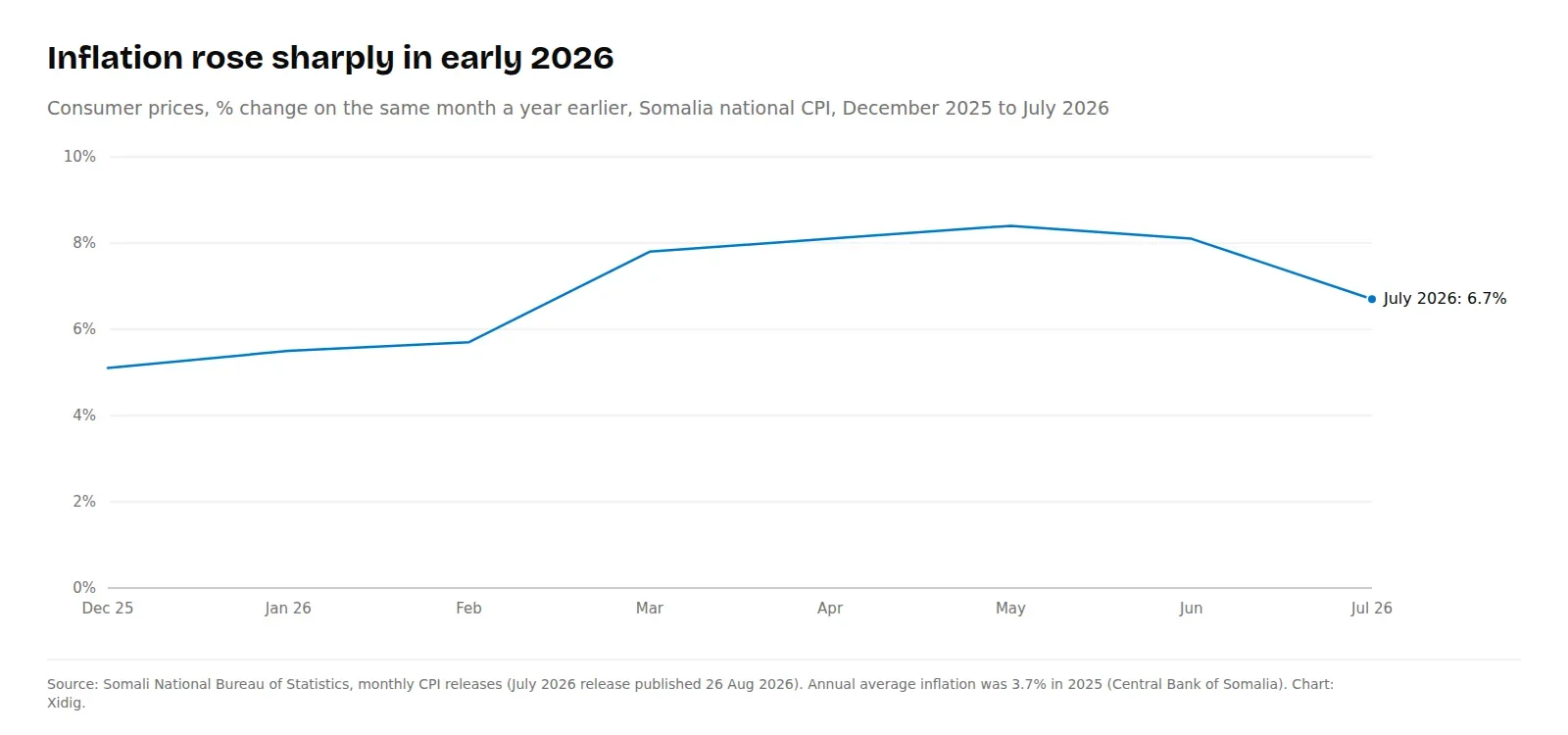
Inflation rose sharply from March 2026. Annual average inflation was 3.7% in 2025.
What the figures mean
Growth and the June 2026 revision.
- Revised series: SNBS revised its national accounts in June 2026. Its reasons included updated balance-of-payments data, a new national consumer price index used from 2022, and a correction to the formula used to deflate exports of services.
- Effect on 2024: 2024 GDP rose from US$11.97 billion to US$12.35 billion, and 2024 growth moved from 4.1% to 4.0%. The Bankable Projects 2026–2030 booklet (p.7) uses the earlier figures.
| 2021 | 2022 | 2023 | 2024 | 2025 | |
|---|---|---|---|---|---|
| GDP, US$ billion (revised) | 9.57 | 10.30 | 11.32 | 12.35 | 13.23 |
| Real growth, % (revised) | 3.5 | 2.8 | 4.2 | 4.0 | 3.1 |
| GDP per person, US$ (revised) | 640 | 671 | 717 | 761 | 793 |
Forecasts for 2026 differ.
- World Bank: growth "projected to slow further to about 2.8 percent in 2026" (Macro Poverty Outlook, April 2026).
- IMF: 3.3% in its December 2025 review, then 2.6% in its April 2026 regional outlook.
- Revisions: neither forecast yet reflects the SNBS revision.
Population is uncertain.
- No recent census: population figures rest on the 2014 Population Estimation Survey and UN estimates.
- World Bank and UN: they estimate about 19.7 million people in 2025.
- SNBS: it projects the 2014 population survey forward at 2.8% a year, which gives a lower total of about 16.7 million (Xidig's calculation from SNBS figures).
- Effect on per-person figures: GDP per person is higher on the SNBS base than it would be on the UN estimate.
Prices.
- Coverage change: until recently, published inflation figures mainly covered Mogadishu. SNBS now publishes a national index.
- Differing 2024 figures: as a result, 2024 inflation appears as 3.3% (Central Bank, World Bank Economic Update) in some sources and 5.5% (Mogadishu only) in others.
- 2026 rise: monthly inflation rose to 8.4% in May 2026. The World Bank's May 2026 Somalia Economic Update projected about 6% for 2026 as a whole (its April outlook said 5.3%).
Remittances. Two measures are often confused.
- IMF balance of payments: remittances were US$2.10 billion in 2023, about US$2.41 billion in 2024 (19.8% of GDP) and a projected US$2.49 billion in 2025.
- Central Bank "secondary income": this includes aid as well as remittances, so it is larger: US$5.09 billion gross in 2025, or US$3.61 billion net (27% of GDP).
Consumption above 100% of GDP.
- The figure: households spend more than the country produces: 123% of GDP in 2025.
- How it is paid for: income from abroad, mainly remittances and aid, makes this possible. Gross national disposable income was US$17.3 billion, against GDP of US$13.2 billion (SNBS).
Trade.
- Imports: goods imports were US$7.30 billion in 2025.
- Exports: goods exports were US$1.26 billion. Livestock exports fell about 3% to US$923 million and made up about 73% of goods exports.
- National accounts basis: including services, net exports were –US$7.2 billion, or –54% of GDP (SNBS).
Investment.
- World Bank: FDI was US$765 million in 2024.
- Central Bank: it reports US$880 million for 2025.
- IMF: its estimate is lower (US$693 million for 2024).
Jobs.
- Modelled estimates: the ILO's modelled estimates put unemployment at 18.9% and youth unemployment at 34.2% in 2025.
- Survey figures: the most recent national labour force survey, in 2019, found 21.4% unemployment and 37.4% among young people. It used a "relaxed" definition that counts people without work who are available to work, even if not actively looking.
Debt and revenue.
- Debt: after debt relief under the HIPC Initiative, public debt is under 10% of GDP (IMF).
- Revenue: the government collects only about 3% of GDP in domestic revenue. Grants roughly double total revenue.
Exchange rate and payments.
- Exchange rate: the Central Bank reports an average of SOS 30,103 per US dollar in 2025, 7.1% weaker than in 2024, and SOS 31,956 in the first quarter of 2026.
- Payments: the Central Bank's 2026 survey found 87% of adults use mobile money, and only 19% hold a bank account (see The new Somali shilling).
Electricity.
- Access: the World Bank's access indicator was 54.4% in 2024.
- Reliability: according to the World Bank's 2026 Somalia Economic Update, 71% of households report access to electricity, but only 21% get more than eight hours of supply a day.
How members can use this page
- Business plans and grant applications: cite the linked sources, not this page's rounded figures.
- Updates: check the "last checked" date. Figures change with each SNBS, Central Bank and IMF release.
- Local knowledge: members with better local figures, such as prices or wages in their town, can share them through Xidig.
What is confirmed, and what isn't
Confirmed
- SNBS revised GDP figures (June 2026) and monthly CPI to July 2026.
- Central Bank 2025 figures for inflation, trade, FDI and the exchange rate.
- IMF remittance, debt and revenue figures (2025 reviews).
Our interpretation
- Consumption above GDP reflects income from remittances and aid.
Not yet verified
- The population: no recent census.
- 2026 forecasts, which predate the SNBS revision.
- The August 2026 CPI, not yet published at the time of checking.
More about the source
- Primary sources: Somali National Bureau of Statistics, Somalia GDP 2025 (30 June 2026) and monthly CPI releases; Central Bank of Somalia, Annual Report 2025.
- Booklet figures: the Bankable Projects 2026–2030 booklet (PDF p.7) gives 2024 GDP of US$11.97 billion and growth of 4.1%, from the earlier SNBS series.
About this report
By Xidig members and collaborators.
How we researched it. Every figure comes from an official or international source, linked below: the Somali National Bureau of Statistics, the Central Bank of Somalia, the IMF and the World Bank. Where sources disagree, we show both and say why. We did not interview anyone for this page.
Updates. This page replaces seven older Xidig economy pages. The date at the top shows when the figures were last checked.
Corrections. If you spot an error, please tell us using the correction link on this page.
Sources
Official statistics
- MoPIED / SOMINVEST, Bankable Projects 2026–2030, p.7 (earlier GDP figures): https://sominvest.gov.so/bankable-projects-in-somalia-2026-2030/
- Somali National Bureau of Statistics, Somalia GDP 2025 (30 Jun 2026): https://nbs.gov.so/somalia-gross-domestic-product-gdp-2025/ · PDF: https://nbs.gov.so/wp-content/uploads/2026/06/Somalia-GDP-2025.pdf
- SNBS, Somalia GDP 2025, methodology notes (2014 Population Estimation Survey projected at 2.8% a year; GNDI): same PDF as above
- SNBS, Somalia GDP 2024 release (Jun 2025), earlier series: https://nbs.gov.so/wp-content/uploads/2025/06/Somalia-GDP-2024-release-text-v3-2025.pdf
- SNBS, "Consumer Price Index (CPI) July 2026" (26 Aug 2026): https://nbs.gov.so/consumer-price-index-cpi-july-2026/ · all releases: https://nbs.gov.so/category/consumer-price-index/
- SNBS, Somali Labour Force Survey 2019 (published 2021): https://nbs.gov.so/wp-content/uploads/2023/05/Somali-Labour-Force-survey-2019.pdf
- Central Bank of Somalia, Annual Report 2025 (2026): https://centralbank.gov.so/wp-content/uploads/2026/08/Annual-Report_2025.pdf
- Central Bank of Somalia, Quarterly Economic Report, Q1 2026: https://centralbank.gov.so/wp-content/uploads/2026/09/Quarterly-Economic-Report_Q1_2026.pdf
- Central Bank of Somalia, Somalia Financial Access Survey Report (2026): https://centralbank.gov.so/wp-content/uploads/2026/08/Somalia-Financial-Access-Survey-Report-2026.pdf
International
- IMF, Country Report 25/191, Third ECF Review (Jul 2025): https://www.imf.org/-/media/files/publications/cr/2025/english/1somea2025001-source-pdf.pdf
- IMF, Country Report 25/335, Fourth ECF Review (Dec 2025), Table 1: https://www.imf.org/-/media/files/publications/cr/2025/english/1somea2025002-source-pdf.pdf
- IMF, Regional Economic Outlook: Middle East and Central Asia (Apr 2026): https://www.imf.org/-/media/files/publications/reo/mcd-cca/2026/english/text.pdf
- World Bank, Macro Poverty Outlook, Somalia (Apr 2026): https://thedocs.worldbank.org/en/doc/bae48ff2fefc5a869546775b3f010735-0500062021/related/mpo-som.pdf
- World Bank, "Somalia: growth continues but shocks and aid cuts intensify risks…" (Somalia Economic Update, 13 May 2026): https://www.worldbank.org/en/news/press-release/2026/05/13/somalia-growth-continues-but-shocks-and-aid-cuts-intensify-risks-to-jobs-and-livelihoods
- World Bank WDI: population SP.POP.TOTL, FDI BX.KLT.DINV.CD.WD, unemployment SL.UEM.TOTL.ZS and SL.UEM.1524.ZS, electricity access EG.ELC.ACCS.ZS (updated 13 Jul 2026): https://data.worldbank.org/country/somalia
Source notes
- The IMF and World Bank use different definitions for remittances and FDI; figures are labelled with their source.
- Figures taken from PDF tables were checked against the published text where possible.